How to get seller leadsfrom your real estate website
By Saad Ali · 10 November 2026 · 8 min read
The valuation pages, seller offers, forms and follow-up that turn a real estate website into a source of listing appointments, with what the research says about how sellers choose an agent.
A real estate website gets seller leads when it gives homeowners a reason to raise their hand before they are ready to pick up the phone. In practice that means three things: a home valuation page worth filling in, one or two seller offers built around the questions owners actually have, and short forms that hand every inquiry to a person within minutes.
It also helps to be honest about the website's role. Most sellers don't discover their agent on a website. They are referred, and then they check you online. A good seller-lead site does both jobs: it captures the owner who is quietly researching, and it convinces the referred seller who is looking you up before the first call.
Where sellers actually find their agent
The National Association of REALTORS® asks recent sellers how they found the agent they hired. The 2025 answers are a useful reality check before you spend anything on lead generation.
| How sellers found their agent | Share of sellers |
|---|---|
| Referred by a friend, neighbor or relative | 37% |
| Used an agent they had worked with before | 29% |
| Direct personal outreach from the agent | 5% |
| Found the agent through a website | 4% |
| Referred by another agent or broker | 4% |
| Met the agent at an open house | 3% |
Source: NAR 2025 Profile of Home Buyers and Sellers. Selected answers only, so the column does not add up to 100%.
Two more numbers matter. NAR found that 80% of sellers contacted only one agent before hiring. Zillow's 2025 consumer research, which asks the question differently, found that 36% of sellers now find their agent through online channels, more than double the 2018 share, and that 59% hired the first agent they spoke with.
Read together, the message is clear. The first conversation usually wins the listing, and your website decides whether you get it. For a referred seller, it is the place they confirm you are the right call. For an owner who hasn't asked anyone yet, it is the place they can start that conversation without feeling sold to.
Three seller offers that earn the inquiry
A contact form on its own asks a homeowner to commit to a conversation they may not be ready for. Seller offers lower that bar by giving them something useful first.
- A home valuation: the classic "What's my home worth?" page. It works because it answers the first question every owner has, and the request tells you their address.
- A local market report: a monthly email on what sold nearby and for how much. It suits owners who are a year or more away and keeps you in front of them until they are ready.
- A plan for their situation: sell-before-you-buy timing, downsizing or relocating. Zillow found that 57% of recent sellers were also buying a home, and 78% said at least one life event influenced their decision to move, most often a change in household size (51%) or a new job (37%). A page written for each of those situations speaks to the reason they are moving, not just the property.
Start with the valuation page. Add the market report next, because it captures the owners who aren't ready yet. Situation pages are the long game, and they double as search content that only you can write.
Instant estimate or agent-prepared valuation?
Many sites plug in an automated valuation that returns a number on screen. It is quick, but automated estimates are least reliable exactly where seller leads live: homes that aren't on the market. Zillow publishes the accuracy of its own Zestimate, and the nationwide median error is 1.80% for homes on the market and 7.21% for off-market homes. On an $800,000 home, 7.21% is about $57,700 either way.
An owner who sees a number that feels wrong either leaves or anchors on it. That is why the stronger offer for most agents is a personal valuation: the owner gives the address and a few details, and you send a considered range, with the recent sales behind it, within a day. If you do show an instant figure as a hook, label it clearly as an automated estimate and invite them to request the agent-prepared version.
A seller doesn't want a number. They want to know what you would do with their home.
How to build a valuation page that converts
- Lead with the address. One field, above the fold, with a clear button. Ask the rest on the next steps once they have started.
- Ask about timing. "When are you thinking of selling?" with options from "within three months" to "just curious" tells you who to call first, and nobody feels judged for picking the last one.
- Ask for contact details last, and only what you need: name, email and phone. Explain why you need the phone number, for example "so we can ask a quick question about the property".
- Say what happens next and when: who prepares the valuation, how it arrives and by when. Vague promises make people hesitate.
- Show the person behind it: your photo, your local sales and genuine reviews, close to the form. Owners are deciding whether to trust you with their address.
- Keep a tap-to-call number visible for the seller who would rather talk now.
- Add a short privacy line saying you won't share their details, and link your privacy policy.
Then test it on your own phone. If the page is slow, the address field is hard to tap or the form jumps around while loading, fix that before anything else.
Put the offer where sellers already are
A valuation page buried in the menu gets few visits. Link to it from every place a homeowner might land:
- A "What's my home worth?" button in the header of every page.
- A short seller section on the home page, separate from the buyer search.
- Every neighborhood page, with wording like "Own a home in this area? Find out what it's worth today."
- Sold listings and past sales, where owners compare their home to what just sold.
- Market updates, blog posts and the footer.
Neighborhood pages matter most here, because they are what owners find when they search their own area. Our article on why IDX alone won't rank your site explains how to build them so Google sends sellers, not just buyers browsing listings.
Follow-up: where most seller leads are lost
A valuation request is a homeowner opening the door a little. Research published in Harvard Business Review on how companies handle online sales leads found that most respond nowhere near fast enough, and in a market where most sellers talk to one agent, a slow reply can hand the listing to someone else.
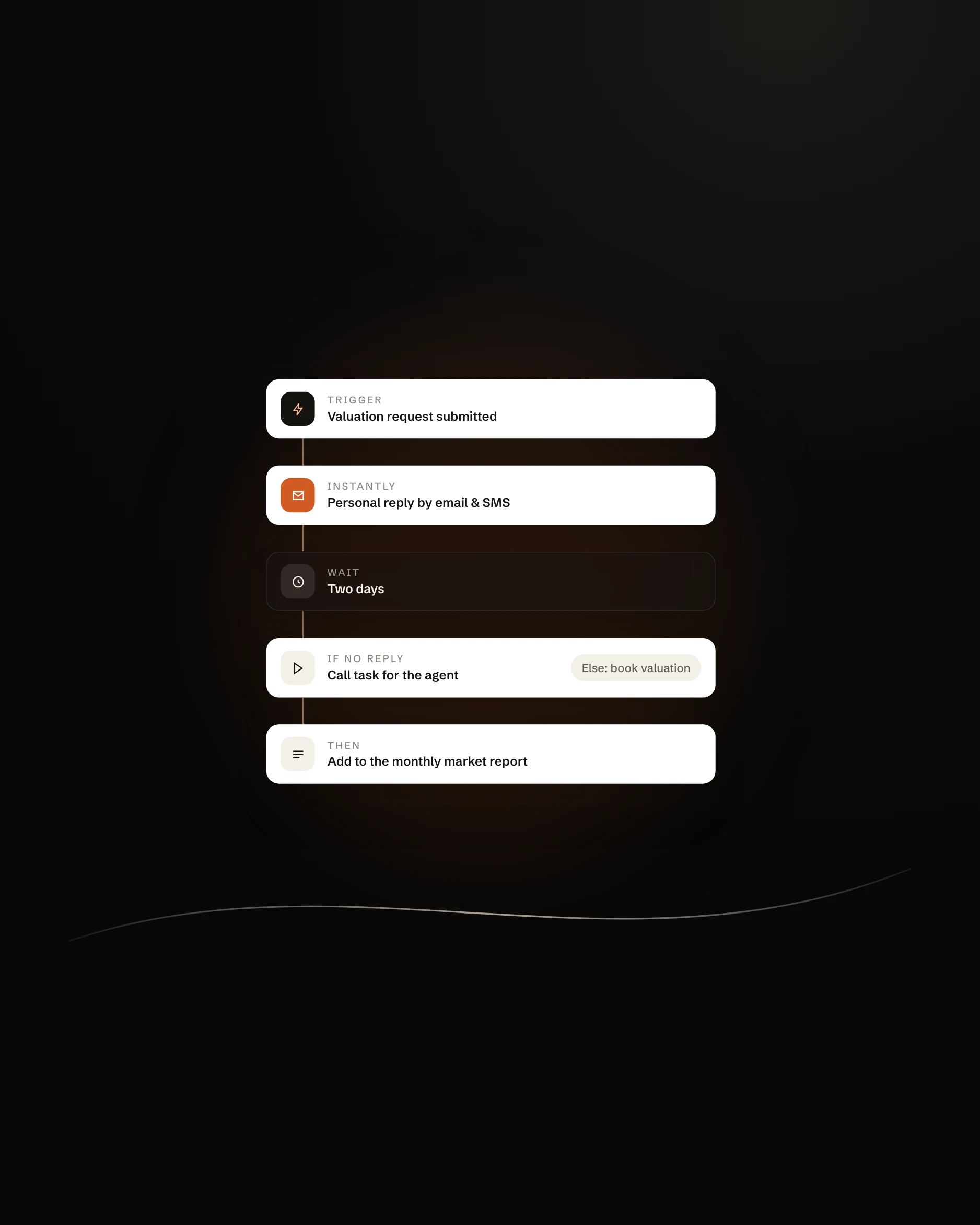
Set the follow-up up once so it runs every time:
- An instant, personal reply by email and text that confirms the request and says when the valuation will arrive.
- A same-day call task for the agent, with the address and timing answer already attached.
- The valuation delivered as promised, with an offer to walk through it on a call or at the property.
- If there's no reply, a short follow-up a few days later, then the owner joins your monthly market report rather than a hard sales sequence.
Every request should land in your CRM, tagged as a seller lead with the address, so nothing depends on someone checking an inbox. Our systems and automation service builds exactly this kind of flow.
Win the referred seller who is checking you out
Most of your listings will still come from referrals and past clients, so the site has to pass inspection when they look you up. Zillow found that 78% of sellers were more likely to hire agents who offer high-resolution photography, and 75% were more likely to hire agents who provide virtual tours and interactive floor plans.
- Show your recent sales and how you marketed them, with the photography and video front and center.
- Publish genuine reviews from sellers, not just buyers.
- Explain your selling process in plain steps, so they know what working with you looks like.
- Make the next step obvious on every page: book a valuation or call.
If your listing videos aren't pulling their weight, our guide to what makes a listing video sell covers what to fix in the edit.
A quick seller-lead check for your site
- Is there a seller offer in the header and on the home page?
- Does the valuation form start with the address and ask about timing?
- Does every neighborhood page link to the valuation?
- Does a person reply to a new request within minutes, not days?
- Does every request land in your CRM, tagged as a seller lead?
- Would a referred seller find your sales, reviews and process within two clicks?
Our free website scanner checks whether your site has a seller offer, an inquiry form and a tap-to-call number, along with Google's mobile speed test, in under a minute. For the full list, work through the real estate website checklist. If the gaps are big enough that a rebuild makes more sense, our website cost guide compares the options, and our real estate website design service builds sites around seller offers from the start, from $1,000 with a fixed-scope proposal.
Common questions
- What is the best way to get seller leads from a real estate website?
- Give homeowners a useful reason to get in touch before they are ready to list. A home valuation page is the strongest offer, followed by a local market report and pages written for situations like downsizing or relocating. Link the offer from every page, and make sure a person replies to each request quickly.
- Do home valuation pages actually work?
- They work when the valuation is worth having and the follow-up is fast. Automated estimates are least accurate for homes that aren't on the market, which is why a personal, agent-prepared valuation delivered within a day usually earns more trust and more conversations.
- How many fields should a seller lead form have?
- Ask for the address first, then a few details and the seller's timing, and ask for contact details last: name, email and phone. Splitting it into short steps feels lighter than one long form, and every field should be something you actually use.
- Why does my website get buyer leads but no seller leads?
- Usually because everything on it is built for buyers: listing search, saved homes and alerts. Sellers need their own path, with a seller offer in the header, a seller section on the home page and a valuation link on every neighborhood page.
- How quickly should I follow up on a home valuation request?
- As fast as you can: an instant personal confirmation, then a call the same day. Most sellers speak to only one agent before hiring, so the agent who replies first and helpfully is often the one who gets the listing.
Sources
- NAR 2025 Profile of Home Buyers and Sellers: highlights deck (hosted by Rhode Island REALTORS®)
- NAR: Top 10 takeaways from the 2025 Profile of Home Buyers and Sellers
- Zillow: Sellers, results from the Consumer Housing Trends Report 2025
- Zillow: Online research now shapes how most agent relationships begin (2025)
- Zillow: Zestimate accuracy
- Harvard Business Review: The Short Life of Online Sales Leads
Free website scanner
See how your own site scores.
28 real estate checks and Google's mobile speed test, in under a minute.